

Imagine gazing out over a peaceful reservoir or a quiet man-made lake — still waters, wide open, seemingly unused. Now picture those same waters quietly generating clean electricity, enough to light up entire communities. No towering turbines. No sprawling solar fields replacing farmland. Just rows of solar panels gently floating, soaking in sunlight. It might sound like science fiction, but it’s already real.
This innovation is called floatovoltaics — and while it’s not dominating energy headlines just yet, it’s quietly redefining how we harness solar power. Instead of taking up valuable land, these floating solar setups transform unused water surfaces — from treatment ponds to reservoir systems — into powerful clean energy producers.
The potential here is huge. Research shows that if just 10% of the world’s reservoirs were topped with floatovoltaics, the energy generated could meet or even exceed the national demands of entire countries like Rwanda or Papua New Guinea. For nations facing land shortages, frequent droughts, or rapid urban growth, floating solar may not just be an upgrade — it could become a lifeline.
And the benefits go beyond renewable electricity. These solar arrays also shade the water, naturally reducing evaporation — a small but meaningful solution in areas struggling with water conservation. They may even help minimize harmful algae blooms by cutting back sunlight exposure on still water.
In this blog, we’re discussing how floatovoltaics are quietly transforming the energy landscape — where they’re already working, why they matter now more than ever, and how this emerging technology could power communities while protecting our water resources.

So… What Happens When You Put Solar Panels on Water?
Not every roof is cut out for solar. Some are too shady (thanks to trees), some are too small, and others need more fixing than they’re worth before you can even think about installing panels. That’s why solar companies have been thinking outside the usual box — trying out ground systems, solar carports… and now? They’re turning to water.
Floatovoltaics , floating solar — are exactly what they sound like: solar panels chilling on top of water. They’re usually placed on quiet, still spots like reservoirs, ponds, or man-made lakes. It’s not fancy or futuristic-looking — just solid solar tech, doing its thing while drifting above the surface.
And the panels? Nothing wild. Same type you’d see on a rooftop or out in a solar field. The difference is they’re mounted on tough floating platforms made from rust-resistant materials — often heavy-duty plastic that can handle a whole lot of weight without tipping or cracking. It keeps everything stable, dry, and safely floating.
The idea’s been around for a while — since at least 2008 — but it’s starting to catch on in a real way. Countries like Japan and China jumped in early, and now we’re seeing more of it in places like the U.K. and across the U.S., especially in states like New Jersey and California where land is limited and pricey.
What makes it clever is that it doesn’t take up space we’re already using. No need to clear forests or pave over farmland. Floatovoltaics just make use of water that’s already sitting there — turning it into quiet, clean power without making a fuss.
Read More: Should You Buy Tesla Solar Panels in 2025? What the Data and Users Say
How Floating Solar Systems Actually Work

Floating solar is simpler than it sounds. It’s basically the same solar panels we’ve been putting on rooftops for years, just… floating. Instead of sitting on shingles or steel frames in a field, these panels rest on platforms that bob gently on top of water.
Think of it like a giant solar quilt stretched over a calm lake. Each piece locks into the next, forming one big, connected surface. To make sure it doesn’t drift away with the first gust of wind, the whole system is tied down with anchors — either secured to the lakebed or lashed to the shore. Once it’s in place, it just sits there, quietly soaking up the sun and pumping out electricity.
These setups usually go on still water — places like reservoirs, irrigation ponds, water treatment plants, or even flooded mines. Basically, anywhere people aren’t boating, fishing, or growing crops.
Now, the size of these floatovoltaic projects? That’s where things get interesting. Some are tiny, powering local grids or single facilities. Like in Cintegabelle, France — they’ve got a small system with 830 panels spread across about 1,500 square meters. But then there’s the Lazer plant, also in France, which fired up in 2023. That one’s huge — over 50,000 panels spread across 17 hectares, covering more than half the reservoir next to a hydroelectric plant. And if you want scale? China’s Huainan floating solar farm takes the crown. It covers around 800,000 square meters — roughly the size of 110 soccer fields floating side by side.
In terms of how it all works? It’s no different than what you’d expect from land-based solar. Sunlight hits the panels, electricity is produced, and it flows into the grid. But since the panels are floating, they need to be mounted on platforms that can handle the elements — sun, rain, wind, even the occasional storm. Anchors and mooring lines keep them steady and angled toward the sun, no matter what.
Some systems go with simple polymer floats — basically thick, durable plastic pontoons — while others use metal frames that sit on larger buoyant structures. It depends on the location and conditions. But the goal is always the same: keep the panels steady, safe, and productive.
In calmer locations, they might not even need full anchoring, which can actually make installation faster and less disruptive than building on land. Still, builders have to be smart about the materials they use — especially in colder climates where ice and freezing temps can do real damage if the setup isn’t built to handle it.
Most floating arrays still use traditional rigid silicon panels — they’re reliable and well-understood. But newer tech is starting to show up too, like flexible thin-film panels or high-efficiency concentrator systems that are designed for specific environments.
So, yeah — it’s solar. Just floating. It doesn’t take up land. It works quietly. And it’s making better use of the space we usually overlook.
Why Floating Solar Is Suddenly Getting So Much Attention
Finding wide-open space for solar panels isn’t always easy. Rooftops only go so far, and big fields often come with competition from farmers, developers, or city planners. That’s part of why floating solar — or floatovoltaics — is quietly catching on in more places than you might think.
This isn’t a brand-new idea. The first floating panels hit the water back in 2007. Since then, the technology has steadily picked up speed. Countries like Japan, where land is tight, jumped in early with dozens of floating solar projects. China took it even further — they now hold around 75% of the world’s total floatovoltaic capacity. And now, others like South Korea, the U.K., and the U.S. are beginning to step in.
But it’s not just about running out of land. Floating solar actually comes with some surprising built-in benefits:
They stay cooler — and work better.
Solar panels tend to lose efficiency as they get hotter. But when they’re sitting on water, that natural cooling effect can boost performance by 15 to 22%. That’s a big deal when you’re trying to squeeze out every watt of energy.
They help save water, too.
All those floating panels create shade — which means less sunlight hitting the water, and less evaporation. In dry, drought-prone places, that can mean millions of gallons of saved water every year. More energy, less water waste — not a bad combo.
They’ve got huge potential.
According to researchers, if we covered just 10% of the world’s reservoirs with floating solar, we’d generate enough electricity to power entire countries — think Rwanda, Ethiopia, or Papua New Guinea. That’s no small feat.
For developing nations, the appeal is obvious. Floatovoltaics offer a cleaner energy path that doesn’t rely on fossil fuels or massive new infrastructure. And since many of these installations can hook right into existing hydropower grids, the upfront investment is lower, and the energy delivery is more reliable.
The U.S. has been a little slower on the uptake — mostly because we’ve had more land to work with. But that’s starting to shift. We’ve got over 24,000 reservoirs that could be used, and recent studies show floating solar could eventually provide as much as 10% of the nation’s total electricity needs.
And it’s not just theory — the numbers are growing fast. Global capacity jumped from 1.3 gigawatts in 2018 to nearly 6 gigawatts by 2022. And by 2030? Experts say we could see that number hit 60 gigawatts.
So yeah — floating solar’s no longer some futuristic idea. It’s shaping up to be one of the smartest, most scalable clean energy solutions we’ve got — especially in a world that’s running out of room and racing toward cleaner alternatives.
Real Stories of Floating Solar That Are Making a Splash
It’s one thing to toss around the idea of floating solar panels — it’s another to watch them quietly transform real landscapes (and waterscapes). Over the past decade, floatovoltaics have evolved from an emerging concept into a reliable source of energy powering homes, towns, and entire regions. Here’s a look at how that’s unfolding around the world:
Huainan, China — A Solar Farm the Size of 110 Soccer Fields
China doesn’t hold back when it comes to renewable innovation, and floating solar is no exception. The Huainan solar park, built over a water-filled former coal mine, now spans more than 800,000 square meters — that’s roughly equal to 110 soccer fields.
Where fossil fuels once defined the landscape, clean energy now floats quietly across the water, delivering power to thousands of homes. China currently leads the globe in floatovoltaic capacity, with over 75% of the world’s total — and they’re still expanding.
Japan — Turning Water Into Energy Where Land Falls Short
In land-scarce Japan, floating solar has become a practical solution. With more than 50 major projects, the country has transformed reservoirs and artificial ponds into hubs of solar energy.
For Japan, it’s about more than electricity. It’s a way to protect green spaces, reduce dependence on imports, and make the most of every usable surface — especially in an island nation with limited room to grow outward.
California & New Jersey — U.S. Projects With Big Potential
In the U.S., floating solar is still gaining ground, but early efforts show real promise. New Jersey’s Sayreville and Canoe Brook systems are among the biggest so far, quietly floating on reservoirs and treatment ponds.
Meanwhile, California is testing a creative twist — placing solar panels above irrigation canals. It’s a two-in-one solution: generate power and reduce water loss in a drought-prone state. Smart, simple, and space-efficient.
Cohoes, New York — A Small Town Taking a Big Step
In upstate New York, the city of Cohoes is proving that size doesn’t matter when it comes to bold ideas. Their city-owned floating solar project will sit atop a 10-acre reservoir, generating clean energy for municipal buildings and saving hundreds of thousands in utility costs.
They’re the first in the state to tackle floating solar at this scale. Despite facing tricky permitting hurdles and funding delays, Cohoes is showing what’s possible — especially with federal support and years of local water data backing the plan. It’s a roadmap other small cities can follow.
Zooming Out — Thousands of Cities Could Do the Same
Globally, the potential is staggering. Studies suggest that covering just 10% of the world’s reservoirs with floating panels could power over 6,000 cities across 124 countries — especially smaller towns often left behind in energy access.
But it’s more than just power. These systems also help conserve water by reducing evaporation, and they improve solar efficiency — boosting output by up to 15% compared to land-based panels.
With large bodies of water across countries like Brazil, India, and the U.S., there’s no shortage of space. And as land-use battles intensify, solar that floats might just be one of the quietest — and smartest — solutions we have.
Upsides of Floating Solar
- Zero land grab: By spreading panels over water instead of soil, floating solar frees up pricey or hard-to-find real estate. That makes it a smart fit for islands, dense cities, and farming regions where every acre already has a job.
- Cooler panels, higher output: Water acts like a natural heat sink, keeping modules a few degrees lower than their rooftop cousins. Field studies show efficiency bumps of roughly 5–15 %—and in a few cases up to 22 %—compared with land-based arrays.
- Naturally cleaner surfaces: With less dust in the air and an easy rinse from wind-blown spray or periodic rainfall, panels stay clearer longer. The result is steadier performance and fewer maintenance visits.
- Water-saving shade: The over-water “blanket” cuts sunlight, trimming evaporation and slowing algae growth. That helps preserve scarce water supplies and improves quality—good news for drought-prone and agricultural areas.
- Perfect partner for hydropower: Mooring a solar raft on a reservoir that already feeds a hydro plant lets both share transmission lines. Solar covers daytime demand, hydropower fills the evening gap, and the combined system runs more smoothly.
Downsides to Keep in Mind
- Bigger up-front price tag: Floating platforms, anchors, and marine-grade cabling add cost compared with a standard ground array.
- Site restrictions: Not every pond will do. Depth, wave action, and water clarity all affect design. Mooring has to be engineered for stable, year-round float.
- Trickier upkeep: Routine checks may call for boats—or even divers—especially in rough or saline environments that stress components faster.
- Limited long-term data: Because the technology is young, there’s still uncertainty about lifespan and payback, which can give cautious investors pause.
- Ecosystem considerations: Covering water alters light and oxygen levels below the surface. Careful monitoring and project-specific safeguards are essential to protect aquatic life.
What’s on the Horizon for Floatovoltaics?
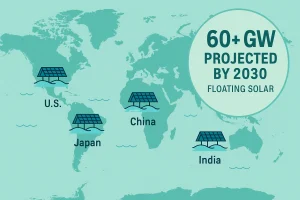
Floating solar might still be the new kid on the energy block, but it’s not staying in the background for long. Industry experts predict we’ll hit over 60 gigawatts of global capacity by 2030 — which means more and more lakes, reservoirs, and man-made ponds will quietly double as power sources in the years ahead.
Right now, most floating setups rely on the same rigid silicon panels you’d see on rooftops or solar farms. But things are shifting. Engineers are starting to test new designs, like thin-film solar panels — especially for tougher spots like offshore projects. These panels are lightweight and flexible, which helps them handle the rise and fall of water and shifting winds. Plus, they can sit closer to the surface, where it’s cooler — boosting efficiency while staying cleaner. Still, offshore floatovoltaics come with their own headaches — like salty air that corrodes parts and concerns about how long everything will hold up.
Another idea that’s starting to get traction? Tracking systems that follow the sun. Since floating panels aren’t bolted into place like they are on land, rotating them with the sun is actually easier. But here’s the trade-off — you’ll need motors and a bit more tech, which bumps up the cost. So for now, most of those sun-tracking systems are still in the testing phase.
Despite those challenges, the momentum isn’t slowing down. In fact, floating solar is expected to expand most in places where calm water is abundant and land is in short supply. As energy demand climbs and land gets more contested — for housing, farming, and conservation — turning to water just makes sense.
A recent study even suggested that over 6,200 cities in 124 countries could meet their entire electricity needs using floating solar alone. That includes all kinds of places — big cities and tiny towns — many of which struggle with energy access or space constraints.
And the future looks even brighter with hybrid systems on the rise. Imagine floating solar paired with hydropower and energy storage — a smart mix that uses the water, sun, and battery backup all in one system. As more developers get involved and the designs get smarter, we’ll likely see more communities testing this out.
For now, all eyes are on places like Cohoes, New York. It might be a small town, but its floating solar project is setting a powerful example. Today’s quiet experiments might just turn into tomorrow’s standard — changing not just where we get our energy, but how we think about space, sustainability, and the water we’ve taken for granted.
FAQs
1. What are floating PV panels?
Floating PV panels — also called floatovoltaics — are just like the solar panels you’d see on a rooftop or solar farm, but instead of sitting on land, they float on water. They’re mounted on sturdy platforms that bob gently on calm bodies of water, like reservoirs, irrigation ponds, or even flooded quarries. The entire setup is anchored in place using cables or mooring lines, so it stays put no matter the weather.
2. How do floating PV panels work?
The setup’s pretty straightforward. Rows of solar panels are arranged on floating structures that sit right on top of the water. Anchors keep them from drifting, and once the sunlight hits, the panels start doing their job — converting sunlight into direct current (DC). Inverters then step in to switch it to alternating current (AC), which gets fed into the local power grid. The water adds a clever bonus: it helps keep the panels cool, which boosts efficiency, and reduces the dust buildup that land-based systems often struggle with.
3. What are the benefits of floating PV panels?
There are quite a few. First off, they don’t eat up land — which is huge for areas where real estate is limited or expensive. The water below naturally cools the panels, improving their performance (sometimes by as much as 22%), and the sunlight bouncing off the water’s surface gives them a little extra energy boost.
They also help protect the water itself. By shading it, they cut down evaporation, which is a big deal in places that face drought. That same shade helps slow algae growth and keeps water quality more stable. Cleaning is easier too — the water’s right there if a rinse is needed.
And from a practical standpoint? Floating solar can often plug into existing infrastructure, like the power lines already set up for hydro plants or water treatment facilities. It’s flexible — you can start small, add more later, and many places offer grants or incentives to get projects like these off the ground.
4. What types of water bodies are suitable for floating PV panels?
Floating solar works best on calm, controlled bodies of water. Think reservoirs, irrigation ponds, old mining pits, and water treatment basins — basically anywhere with still water and no heavy boating, wildlife disruption, or major wave activity. You won’t find them out on the ocean or big recreational lakes, simply because the conditions are too rough and unpredictable.
5. On which water bodies are floating PV panels most useful?
These panels really shine in places where traditional solar setups don’t quite fit. That includes water reservoirs that support treatment plants, hydro dams with existing grid connections, and industrial ponds that aren’t used for public recreation or wildlife. In many cases, it’s about making smart use of space that would otherwise sit unused — and turning it into a clean, quiet source of electricity without disturbing the land around it.


